Bitcoin's increasing adoption and the Fractal Market Hypothesis: a case for lower volatility
An excerpt from my new book Exponential Gold

[This is another excerpt from my new book “Exponential Gold”. Bitcoin is obviously still a volatile asset but there is a strong case to be made that it is transitioning towards a safe-haven asset over time. Read more below.]
With increasing adoption, it is quite likely that bitcoin’s risk and volatility will also decline structurally over time.
The reason is that as market participants become more heterogeneous over time, increasing dissent among buyers and sellers is bound to have a stabilising effect on market prices and volatility.
Imagine a high-frequency trader that might sell a position on account of a short-term trading signal. In contrast, a longer-term buy-and-hold pension fund might see a short-term decline in price as a longer-term buying opportunity — heterogeneity among investors has stabilised the price.
In contrast, market instability usually occurs in environments with increasing consensus and homogeneity among investors, e.g. many investors selling at the same time on account of the same kind of information which can create price gaps/spikes.
This is also the logic of the so-called Fractal Market Hypothesis (FMH) put forth by Edgar Peters83, often considered an antithesis to the dominant Efficient Market Hypothesis. The FMH assumes investors to be heterogeneous, to have imperfect information, and also different investment horizons.
With respect to bitcoin, increasing heterogeneity through wider adoption also implies structurally lower volatility over time.
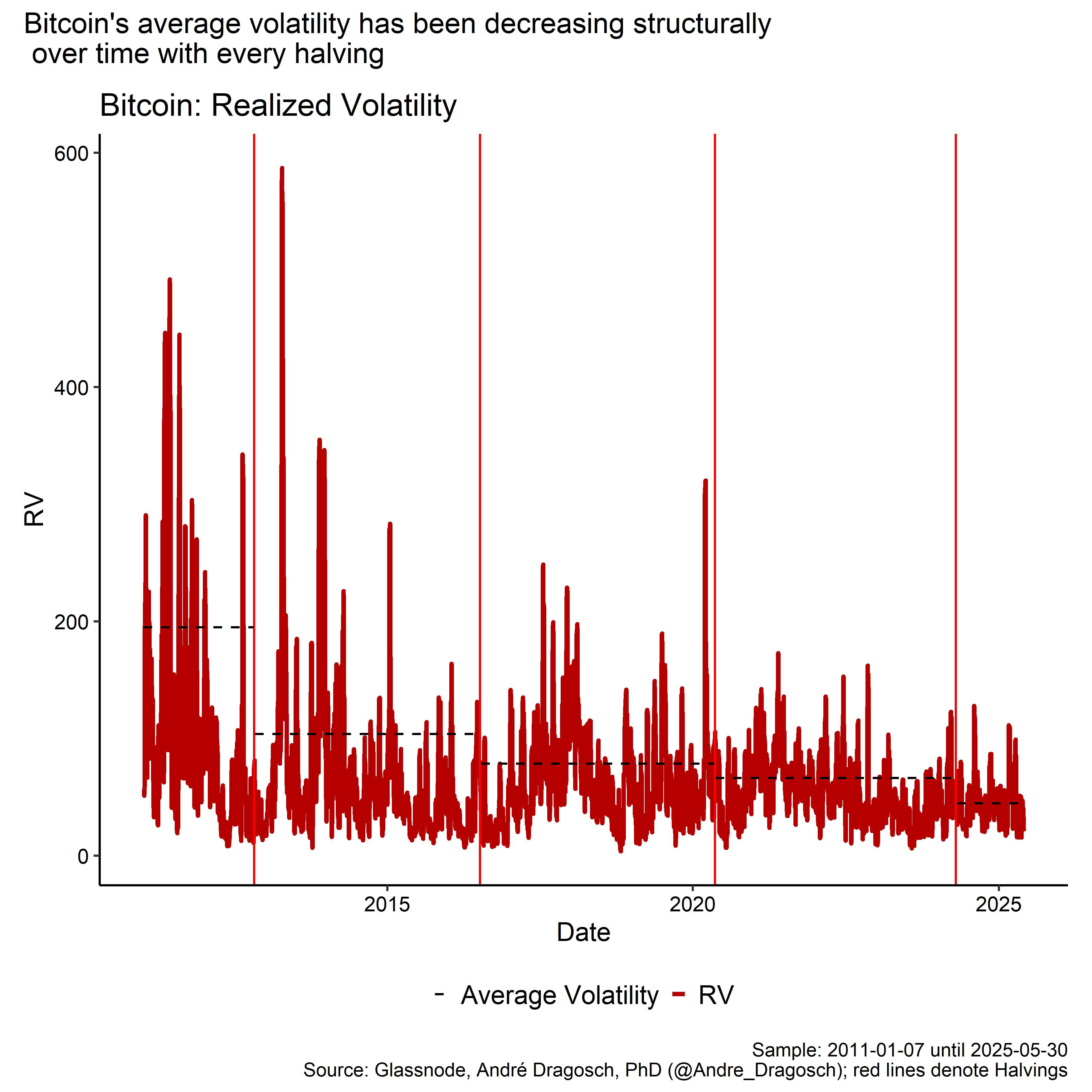
The following chart shows bitcoin’s price performance (upper panel) and its realised volatility (lower panel) over time. The horizontal lines represent the dates of the Bitcoin Halvings.
As one can see, bitcoin’s volatility has been decreasing structurally over time with every Halving.
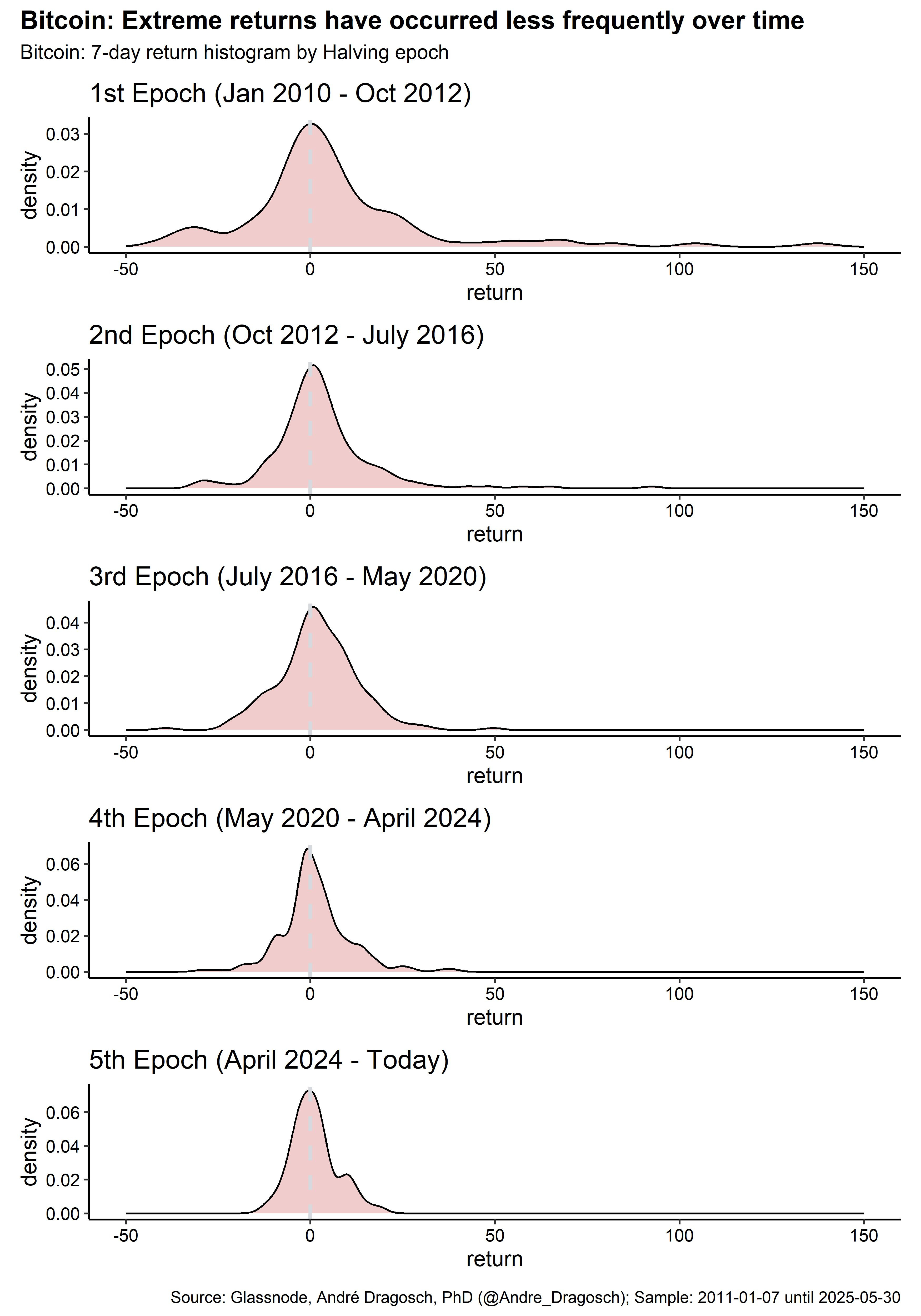
Moreover, not only volatility has decreased but also the occurrence of extreme returns, both negative and positive, has declined significantly with every Halving.
In statistician’s parlance: The return distribution has become less leptokurtic.
This is shown in the following chart- each panel represents a single bitcoin epoch:
Bitcoin Halvings, which were usually followed by significant price appreciation in the past, can also be a significant driver of adoption itself as adoption usually lags increases in price.[1]
The positive investment implication is that the risk characteristics of bitcoin will continue to change over time. As adoption rises, bitcoin will likely evolve from a risky asset with high volatility to a safe-haven asset with low volatility.
The effect of those Halvings on bitcoin’s price performance will be analysed in the following chapter.
Sources: [1] Auer et al. (2022)
[End of excerpt]
Thanks for reading!
Hope you enjoyed this excerpt from my new book!
The book Exponential Gold features a foreword by Samson Mow and delivers institutional-grade insights about how to allocate into bitcoin for serious investors.
Stay humble and stack Sats,
André
If you're a professional / institutional investor, this book is for you!
! Get your copy now from Amazon ! 👇
***** Reviews by professional investors so far *****
“A few weeks ago I had the unique opportunity and honor to review a new book by André Dragosch, PhD and what a quality read it was. The book is tailored specifically for institutional investors, and I can confidently say: it’s outstanding.”
— Janina V.
”The book from André Dragosch, PhD is the most precise book on Bitcoin from an investment-perspective I ever read. 100% endorsement on this one.”— Dr. Sven H.
“Great book! I couldn't stop reading it. Very nice historical journey from the beginning of money until what is the core of money today and what might be. Solid micro and macro economic views, all backed by data and charts from reliable sources.”
— Daniel Z.